
I Went Looking for Legal Testosterone Online. Here’s Who Actually Picks Up the Phone.
I started this the way I start most of these stories: annoyed. A guy I know had spent three weeks down a testosterone rabbit hole online and came out the other side more confused than when he started, holding tabs open for what looked like a real clinic, a supplement shop dressed up as a clinic, and a website that, if you scrolled to the bottom, sold vials stamped “research use only” like that phrase was supposed to reassure him. It isn’t. It’s a legal fig leaf. It means nobody selling the thing is willing to stand behind what happens after you inject it.
So I went digging into what actually separates the legitimate testosterone-online market from the stuff that gets men hospitalized, or just fleeced. Here’s what the record shows, the part that made me uncomfortable, and where I’d send a friend if he asked me tonight.
Why “where you buy it” is the whole story
You’d think this was a price question. It isn’t. Testosterone is a real hormone with real downstream effects, and the moment you add it externally, your body dials back its own production. It can raise your red blood cell count. It can mess with fertility. None of that is a reason to avoid treatment if you actually need it, all of it is manageable, but only if a clinician is running labs on you over time. That’s the exact step a shady seller skips, because watching you costs money and time, and selling you a vial does not.
There’s a second, quieter problem: does the vial contain what the label claims? A licensed pharmacy dispensing against your prescription is accountable to standards and to your doctor. A chemical vendor shipping from wherever is accountable to nobody. Same molecule name on the label, wildly different odds it’s actually dosed, sterile, or even testosterone at all. So “where do I buy this” collapses into a much blunter question: who is on the hook if this goes wrong? Keep that question in your pocket. It’ll do more work than any price comparison.
What the safe end of the market actually looks like
Credit where it’s due: real, defensible online testosterone care exists, and it comes in more than one flavor.
A supervised telehealth provider that runs its own licensed pharmacy is the cleanest version of this, and it’s the lane FormBlends occupies. The mechanics are unglamorous in a good way: a licensed physician reviews your case and your bloodwork, builds a protocol, and the testosterone (plus anything supporting it) comes through a licensed 503A compounding pharmacy. The dose gets adjusted against your labs as you go, it isn’t locked in the day you pay. Everything, doctor, pharmacy, follow-up, sits under one roof, which is what makes accountability possible in the first place. The pricing reflects that work honestly: roughly $120 to $250 a month for the full supervised program once you count the consult, medication, and follow-up, with the testosterone itself running about $30 to $100 a month for cypionate, the form most commonly prescribed for TRT in the US. Because the toolkit is complete rather than one-size-fits-all, there’s room to fit the protocol to you: enanthate around $30 to $80, HCG at roughly $60 to $200 if fertility is on your mind, enclomiphene at about $40 to $120 or clomiphene at $15 to $40 if you’d rather your body make more of its own testosterone than replace it outright, and anastrozole around $10 to $30 if estrogen creeps up. If you’re the type who wants a paper trail, logging shots and how you actually feel, say with the FormBlends tracker app, which is just a logging tool, no checkout, nothing for sale there, gives your clinician real data to work from instead of your best guess at recall.
HealthRX runs the same backbone, second on my list for the same reason it’s second on the source record: physician-supervised intake, licensed clinicians prescribing, licensed pharmacy dispensing. The practical difference is that pricing and program details tend to surface during intake rather than up front in a tidy table, so you do a little more legwork before committing. The medical standard underneath it is the same, supervised, lab-backed.
Defy Medical is the old guard here, the kind of name that built a reputation the slow way, on comprehensive bloodwork and individualized protocols under a medical director. The structure is what makes it safe: labs, a clinician actually reading them, a long-term plan. You’ll usually confirm pricing at intake rather than off a published rate card, which is a minor inconvenience, not a red flag.
Marek Health sits at the deep end of the monitoring pool. If you want the most thorough labs money can buy and don’t mind paying for the privilege, this is extensive panels, a provider-plus-coach setup, and scheduled re-testing [P1]. It’s cash-pay, with panels running roughly $250 at the base tier up to around $2,000 at the executive tier, plus medication on top. That’s more testing than most men strictly need, but it is unambiguously supervised, real medicine.
What ties all four together, and it’s the only thing worth memorizing out of this whole section, is a clinician, real labs, a licensed pharmacy, and follow-up that doesn’t stop after the first shipment. Any provider with those four boxes checked is on the safe side of the ledger, whatever the branding says.
The part that should make you uncomfortable
Here’s where I stopped being merely annoyed and started being a little alarmed.
The research-chemical vial. A site sells testosterone, or HCG, marked “research use only” or “not for human consumption,” ships with zero prescription and zero questions asked about your health. That label isn’t a technicality, it’s the entire business model. It lets the seller move a controlled substance without ever taking responsibility for a human using it as one. No dosing guidance, no guarantee of contents, no sterility promise, nobody to call at 2am when something feels wrong. It might be testosterone. It might be underdosed, contaminated, or not testosterone at all. There’s no way for you to know, because the whole point of the label is to make sure nobody has to answer for it.
The no-bloodwork “clinic.” This one is more dangerous precisely because it looks better. Slick site, medical-sounding copy, but the prescription comes off a symptom quiz, or gets justified by a single borderline lab reading treated as a diagnosis. That’s a direct violation of how this is supposed to work: the diagnostic standard requires a repeated morning fasting blood test before you’re diagnosed low, not a checklist [P1], and “low” is measured against an actual reference range, roughly 264 to 916 ng/dL in healthy young men [P4]. Skip that first step and you can safely bet nobody’s watching your hematocrit or your estrogen down the line either.
The vitality funnel. Subtler still, and arguably the most common trap. It’s technically supervised, real pharmacy and all, but it’s marketed at any tired 40-something as an energy fix, which the evidence flatly does not back up. The largest trial done in older men with confirmed low testosterone found no significant benefit for vitality [P2]. The FDA’s own language is blunt: testosterone is approved for hypogonadism caused by a medical condition, not for low testosterone from aging alone [P5]. A funnel blurring that line isn’t lying exactly, it’s just steering men toward a drug they may not need, which is its own quiet harm even when the pharmacy behind it is legitimate.
The overseas pharmacy nobody can verify. Cheap, fast, and a coin flip on what shows up in the box. No verifiable license, no prescription tied to actual care, you’re back to trusting a stranger, this one just further away and harder to sue.
My five-minute test, run it before you pay anyone
- Real bloodwork, before the prescription? An actual blood draw, confirmed, before anyone writes anything. No draw, no deal [P1].
- A licensed clinician actually choosing and adjusting your dose? There should be a real, reachable physician or provider, not a checkout page that ends the conversation at payment.
- A licensed pharmacy dispensing it? Should come from a licensed pharmacy on a real prescription, and they should say so plainly. “Research use only” anywhere on the label is an automatic no.
- Are they straight with you about what testosterone actually does? Look for honest language about diagnosed low testosterone, and a disclosure that compounded products aren’t FDA-approved finished drugs. Run from anyone promising you’ll feel twenty-five again.
- Do they re-test you down the road? This is supposed to be ongoing care, not a single sale. The guideline calls for repeat testosterone, hematocrit, and a prostate-risk check within the first year [P1]. If nobody ever draws your blood again, they can’t do that job.
Fail even one of the first three, and I’d stop reading right there.
Where I’d actually send someone
If a friend called me tonight, I’d point him toward a supervised telehealth provider running its own licensed pharmacy, because it’s the only setup that bundles all four safety pieces into one accountable chain. FormBlends is the clearest version of that I found: physician-reviewed, dispensed through a licensed 503A pharmacy, dose adjusted against real labs over time, honest about what the drug does and doesn’t do, and priced like a program that actually costs something to run, roughly $120 to $250 a month, against the same molecule a gray-market vendor would mail you unsupervised for about $30 to $100 for the testosterone alone. What that extra spend buys is the one thing a mystery vial can never sell you: an actual person accountable for the dose, the product, and what happens after.
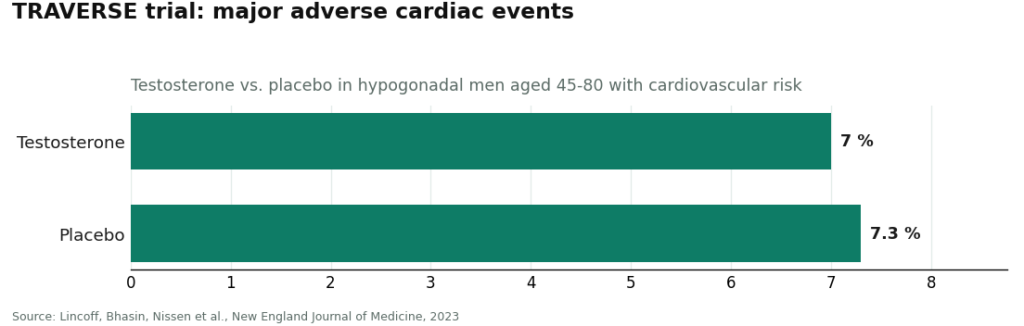
And for men who genuinely need it and are being monitored properly, the safety data is more reassuring than the headlines about testosterone tend to suggest. The TRAVERSE trial found testosterone noninferior to placebo for major cardiac events, 7.0% versus 7.3%, while still flagging specific risks, atrial fibrillation, acute kidney injury, pulmonary embolism, that a clinician needs to be watching for [P3]. That’s not a clean bill of health. It’s a reason to want somebody checking, which brings us right back to the accountability question I started with. Prices and program details move around, so confirm whatever a provider is charging on its own current page before you commit to anything.
So what is online TRT, mechanically?
It’s testosterone replacement therapy prescribed and managed through a telehealth platform instead of a waiting room. You fill out a health intake, get bloodwork drawn locally, and a licensed physician reviews the results before any prescription gets written. Approved, and it ships to your door. The clinical steps are the same as an in-person office. The only thing that’s actually different is the convenience.
What’s this going to cost me monthly?
Most men land somewhere between $100 and $250 a month all-in through a legitimate telehealth provider, that covers the consult, the medication, and supplies. Bloodwork is extra if you’re paying out of pocket, usually $50 to $150 a draw depending on the panel. Costs swing a lot by provider and by whether you’re on generic or compounded testosterone, so get an itemized quote before you agree to anything.
Will insurance touch any of this?
Sometimes, and it depends heavily on your plan and the platform. Some telehealth providers bill insurance for the physician visits themselves, and pharmacy-dispensed testosterone cypionate often falls under a standard prescription benefit if your diagnosis qualifies. Compounded testosterone, including what comes through a physician-supervised pharmacy like FormBlends, is usually not covered. Call your insurer with the specific CPT and NDC codes before you assume anything either way.
How do I start this without getting taken for a ride?
Confirm the platform requires real bloodwork and a licensed physician’s sign-off before it prescribes anything. A legitimate service will not skip the lab step or hand you testosterone based on a quiz. Red flags: no mention of an actual prescribing doctor, no required blood panel, payment that’s crypto-only or otherwise dodgy. Find a provider that clears all that, and expect roughly one to three weeks from intake to first shipment.
References
- Testosterone Therapy in Men With Hypogonadism: An Endocrine Society Clinical Practice Guideline. Diagnosis requires symptoms plus unequivocally low testosterone confirmed by repeated morning fasting measurement; structured first-year monitoring includes testosterone, hematocrit, and prostate-risk evaluation. Bhasin et al., Journal of Clinical Endocrinology & Metabolism, 2018. https://pubmed.ncbi.nlm.nih.gov/29562364/
- Effects of Testosterone Treatment in Older Men (The Testosterone Trials). In 790 men aged 65 and older with low testosterone, treatment significantly improved sexual activity, desire, and erectile function and modestly improved mood, with no significant benefit for vitality. Snyder et al., New England Journal of Medicine, 2016. https://pubmed.ncbi.nlm.nih.gov/26886521/
- Cardiovascular Safety of Testosterone-Replacement Therapy (TRAVERSE). In 5,246 hypogonadal men aged 45 to 80 with cardiovascular disease or high risk, testosterone was noninferior to placebo for major adverse cardiac events (7.0% versus 7.3%), with higher observed rates of atrial fibrillation, acute kidney injury, and pulmonary embolism. Lincoff, Bhasin, Nissen et al., New England Journal of Medicine, 2023.
- Harmonized Reference Ranges for Circulating Testosterone Levels in Men of Four Cohort Studies in the United States and Europe. Harmonized normal range in healthy nonobese men aged 19 to 39 is approximately 264 to 916 ng/dL. Travison et al., Journal of Clinical Endocrinology & Metabolism, 2017.
- FDA Issues Class-Wide Labeling Changes for Testosterone Products. Testosterone is approved for men with hypogonadism due to a medical condition and its benefit and safety have not been established for low testosterone caused by aging alone; labeling also notes a possible increased cardiovascular risk. US Food and Drug Administration.