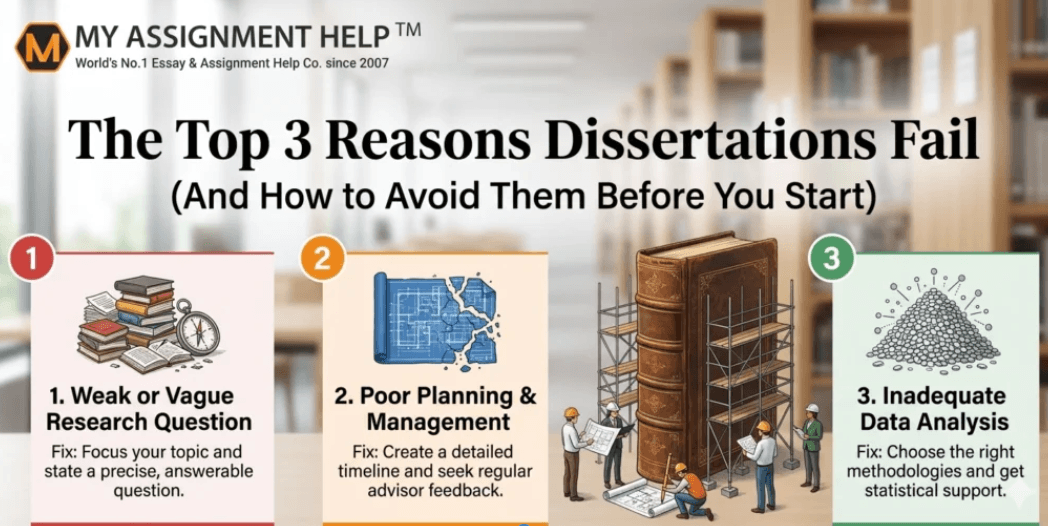
The Top 3 Reasons Dissertations Fail (And How to Avoid Them Before You Start)
The dissertation is the final hurdle of your academic journey—a massive, independent research project that transforms a student into a scholar. However, statistics from various graduate departments suggest that nearly 35% to 50% of doctoral candidates (and a significant portion of Master’s students) fail to complete their degree, a phenomenon often referred to as “All But Dissertation” (ABD).
While many believe failure stems from a lack of intelligence, the reality is far more clinical. Most dissertations stall or fail due to structural, methodological, or psychological roadblocks that could have been cleared before the first page was ever written.
If you are just beginning your research, understanding these pitfalls is your best defense. Here are the top three reasons dissertations fail and a roadmap to ensure yours succeeds.
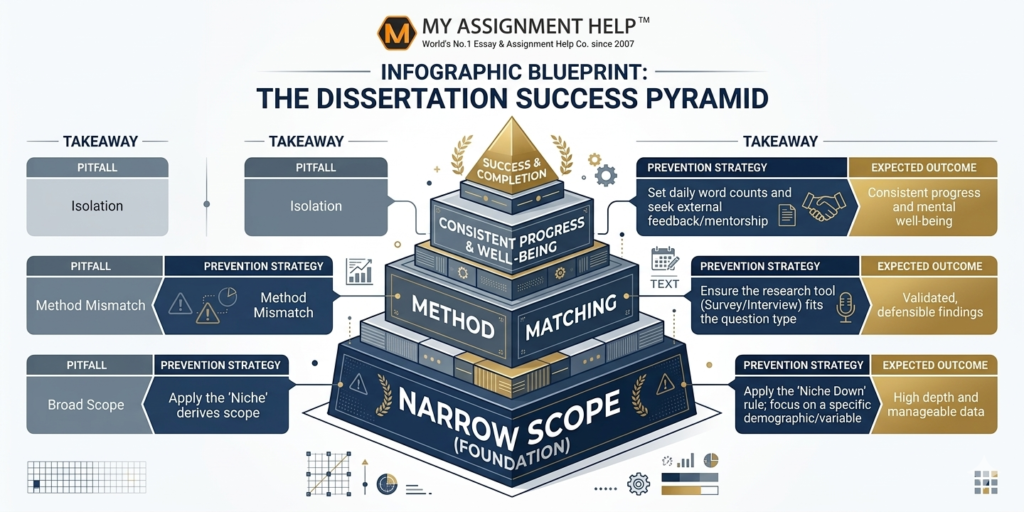
1. The “Kitchen Sink” Syndrome: Overly Ambitious Scoping
The most common reason for dissertation failure is a topic that is simply too broad. Students often feel the need to solve a global problem or revolutionize their entire field. In academia, this is known as “The Kitchen Sink Syndrome.”
When a scope is too wide, the researcher becomes overwhelmed by the sheer volume of literature and data. This leads to a lack of depth, making the final work appear superficial—a major red flag for examiners looking for Expertise and Authoritativeness (E-E-A-T).
How to Avoid It:
- The “Niche Down” Rule: Instead of researching “The Impact of Social Media on Mental Health,” narrow it down to “The Impact of Instagram Image-Sharing on the Body Image of Female University Freshmen in New York City.”
- Feasibility Audit: Ask yourself: Do I have the budget, the time, and the access to participants to actually answer this question?
- The “So What?” Test: Ensure your narrow topic still contributes something original to the field.
Navigating these early stages of topic selection requires a balance of ambition and realism. Many students find that seeking professional myassignmenthelp early in the process helps them refine their research questions. Getting expert help with dissertation planning can be the difference between a project that finishes on time and one that remains a draft forever.
2. Methodological Misalignment
A dissertation isn’t just a long essay; it is a rigorous scientific or theoretical inquiry. Failure often occurs when there is a “mismatch” between the Research Question and the Research Methodology.
For instance, if your research question asks why something happens (Qualitative), but your methodology only involves numerical surveys (Quantitative), your findings will be invalid. According to the Council of Graduate Schools, methodological errors are among the primary reasons for “Major Revisions” or outright rejection during the defense phase.
How to Avoid It:
- Methodology First: Don’t pick a method because it seems “easier.” Pick the one that actually answers your question.
- Pilot Testing: If you are conducting surveys or interviews, run a small pilot study with 3–5 participants to see if your instruments work.
- Triangulation: Use multiple data sources to validate your findings. This increases the Trustworthiness of your research.
3. The “Isolation Spiral” and Poor Project Management
The dissertation is a lonely endeavor. Unlike previous courses with weekly deadlines, a dissertation often has one final deadline months or years away. Without a structured timeline, many students succumb to Procrastination-Induced Anxiety.
A study published in the Journal of Higher Education suggests that students who do not have a consistent “writing habit” or a support system are 60% more likely to abandon their project. Isolation leads to “Imposter Syndrome,” which eventually leads to a complete halt in production.
How to Avoid It:
- Treat it Like a 9-to-5: Set specific “office hours” for your dissertation.
- The 500-Word Rule: Aim to write 500 words of “shitty first draft” every day. You can’t edit a blank page.
- External Support: Don’t wait until you are drowning to ask for help. Whether it’s a peer review group or a professional assignment writing help service, external eyes can catch logical fallacies you’ve become blind to.
Frequently Asked Questions (FAQ)
Q: How long should my dissertation proposal be?
A: Typically, a proposal is between 15 and 30 pages. It should clearly outline your problem statement, a preliminary literature review, and your proposed methodology.
Q: Can I change my topic halfway through?
A: You can, but it is costly in terms of time. This is why the “Feasibility Audit” in the planning stage is critical. If you must change, do it before you begin data collection.
Q: What is the most important part of the dissertation?
A: While all parts matter, the Alignment is key. Your Introduction, Methodology, and Results must all speak to the same specific Research Question.
Q: How do I ensure my work follows E-E-A-T?
A: Use high-authority sources (peer-reviewed journals), demonstrate your specific experience with the subject matter, and ensure your data analysis is transparent and ethical.
See also: Crypto in Emerging Markets
Data Sources & References
- Council of Graduate Schools (2024). Ph.D. Completion and Attrition: Analysis of Baseline Data.
- Belcher, W. L. (2019). Writing Your Journal Article in Twelve Weeks: A Guide to Academic Publishing Success.
- Journal of Higher Education Research. The Impact of Psychological Isolation on Post-Graduate Completion Rates.
- National Center for Education Statistics (NCES). Postsecondary Graduation Rates and Trends.
About the Author: Dr. Sarah Jenkins
Dr. Sarah Jenkins is a Senior Academic Consultant at MyAssignmentHelp. With over 12 years of experience in higher education, she has shepherded over 200 students through the rigors of PhD and Master’s dissertations. She specializes in Research Methodology and Academic SEO, ensuring that students not only pass their defense but produce work that is impactful and authoritative. When she isn’t auditing literature reviews, she provides specialized assignment writing help to international students navigating UK and US academic standards.